
Johnston Parole and Probation Compared
Probation is a court-ordered sentence served in the community, often instead of an active prison term or after a short period of confinement. Parole is conditional release under an older or specially eligible sentence. Post-release supervision is the modern supervision period that can follow release from a North Carolina prison. The North Carolina Post-Release Supervision and Parole Commission makes parole and post-release decisions within its legal authority and sets conditions. NC Department of Adult Correction Community Supervision officers handle day-to-day supervision in the community.
North Carolina Structured Sentencing applies to most offenses committed on or after October 1, 1994, so ordinary discretionary parole is mainly relevant to eligible older-law cases and specified exceptions. A person can leave prison on post-release supervision without being on parole. The public DAC search groups active probationers and parolees in one status filter, which makes the record detail essential.
| Supervision type | How it begins | Best verification source |
|---|---|---|
| Probation | A court imposes a community sentence or suspends an active sentence. | DAC supervision record plus the court judgment. |
| Parole | The Commission grants conditional release in an eligible case. | DAC offender detail and Commission decision sources. |
| Post-release supervision | A covered prison term moves into its statutory community-supervision phase. | DAC status, incarceration history, and supervision record. |
A custody release and a supervision discharge are separate events. The first ends physical confinement with that custodian. The second ends the community-supervision term after the supervising authority records completion or another lawful disposition.
- Discharge
- The recorded end of a correctional or supervision term.
- Absconder
- A person whom DAC reports as having stopped complying with required supervision contact.
- Detainer
- A request or hold from another authority that can affect custody or release.
- Revocation
- A court or authorized body ends community supervision and may activate confinement after required proceedings.
Verify Johnston County Post-Release Supervision
The official public starting point is NC DAC Offender Public Information. It offers All, Active Inmate, Active Probationer/Parolee, and Inactive filters. Search All when the status is uncertain. An offender ID is stronger than a name alone because similar names and aliases can create false matches. Compare the identity information, open the full person record, and read the supervision and sentence entries in context.
- Select Active Probationer/Parolee, or use All if custody or supervision status is unclear.
- Search by offender ID when known. Otherwise enter the name and narrow with birth, age, sex, race, or ethnicity fields only as needed to distinguish records.
- Open the matching record. Check status, sentence data, incarceration history, county of conviction, and every current supervision entry.
- Identify the supervising district or office shown in the record. Contact that office when the supervised person or an authorized participant needs current reporting directions.
- Reconcile the DAC record with the judgment or later order in the North Carolina eCourts Portal or the Johnston Clerk file.
A person listed as Active Probationer/Parolee may be outside prison and still under DAC authority. An Inactive result is broader. It does not, by itself, prove that every sentence, hold, court duty, or supervision term has ended. Read the detail and confirm the specific term. The full Johnston County release verification path is also explained on the released-inmate search home page.
NC SAVAN can send custody-status alerts for participating county and state records. It is useful when custody changes while a supervision issue is pending. An alert is not a court judgment, and a missing result is not proof that the person is free of supervision.
Johnston County Supervision Office
Johnston County is served by NC DAC Community Supervision Judicial District 11. The official field roster dated September 11, 2025 places the regional office in Smithfield and says the district also serves Harnett and Lee counties. This is a state supervision office, not a Johnston County Sheriff unit. Staff may confirm public office information while limiting disclosure about a named person, private appointments, safety plans, or other protected details.
NC DAC Community Supervision, Judicial District 111327 Brightleaf Boulevard, Suite C
Smithfield, NC 27577
Phone: 919-934-9970
Fax: 919-934-9388
Check the current DAC district and local-office directory before travel because rosters, staffing, and office assignments can change. The older Johnston resource directory listed separate Clayton and Smithfield locations, but the newer official field roster controls. A public search result should never be used to infer a private visit time or residence.
Note: Direct reporting questions should come from the supervised person or an authorized participant and go to the assigned officer or current office.
Johnston Parole Violations and Absconders
Conditions depend on the judgment, release decision, and supervision plan. They may address reporting, travel, treatment, contact, payments, or other lawful requirements. A missed or alleged breach does not itself establish a new conviction. The officer, court, or Commission follows the process that applies to the supervision type and alleged conduct.
The NC DAC Absconders search is a distinct statewide tab for people whom DAC reports as absconders from supervision. It is not a list of every Johnston County warrant. JCSO did not provide a verified public county warrant list in the research sweep, and its older detention information says warrant status is not provided by phone. If the person appears in the current Johnston jail roster, that roster establishes present custody as of its timestamp, not the final result of the allegation.
The official DAC absconder interface shows why the status requires a dedicated check:
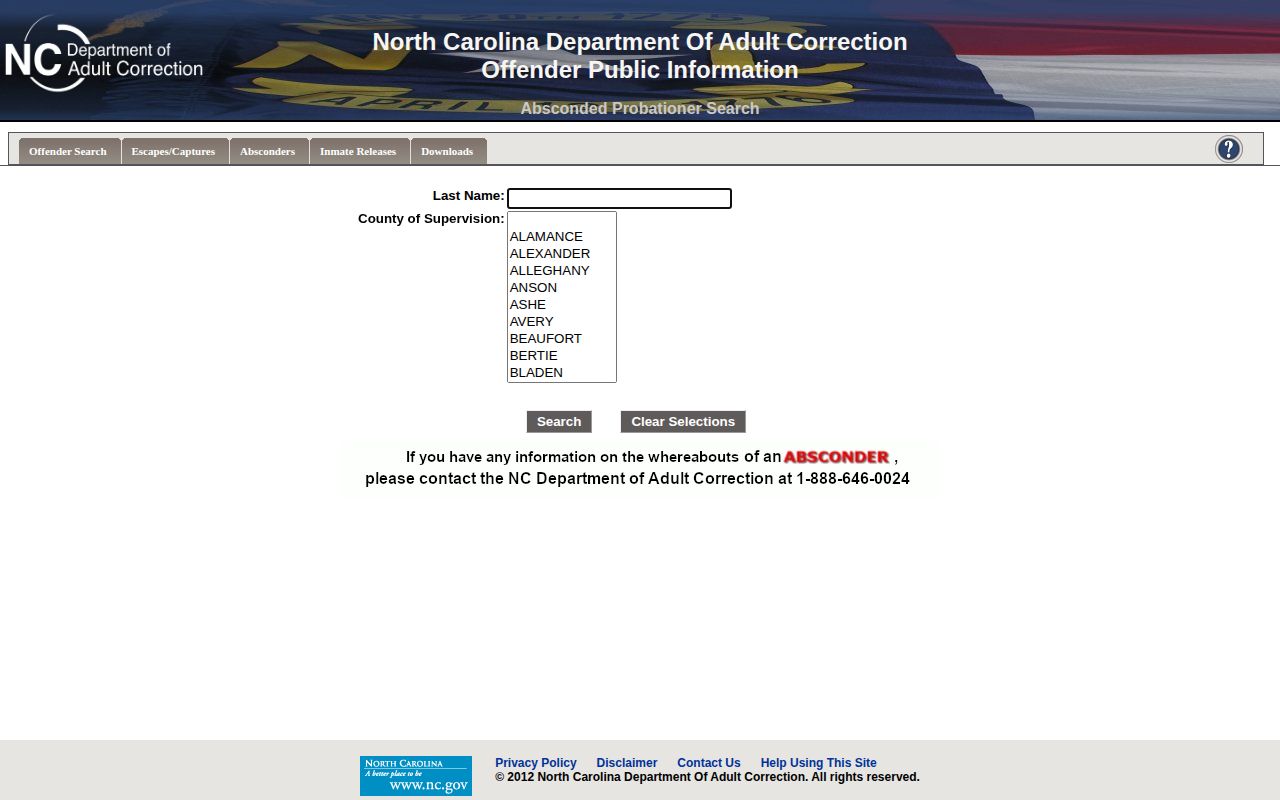
Confirm the matching offender ID and open the related record before drawing any conclusion. An absconder label describes DAC’s supervision status. It is not proof of guilt on a new offense, and it does not reveal the outcome of any later court proceeding.
Johnston Post-Release Roster Terms
Johnston’s current housed roster sometimes uses charge descriptions such as “POST RELEASE VIOLATOR,” “POST RELEASE / PAROLE VIOL,” “PAROLE WARRANT,” or probation-violation wording. Those phrases can be easy to misread. The person is on the list because JCSO reports the person as currently housed at the time shown. “Post release” describes the alleged supervision context, not a fresh community release.
Read the roster heading, timestamp, and charge label together. A charge is an allegation, not an adjudication. Then check the DAC supervision record and the court file for the relevant order or disposition. Disappearance from the live roster is also inconclusive. It may reflect community release, transfer to DAC, movement to another county, or another custodial change.
Johnston Parole Review Records
The North Carolina Commission does not run a conventional public parole-hearing calendar. Its official process says commissioners review files and vote individually rather than conducting formal hearings or meeting personally with offenders. That distinction matters for eligible Johnston County cases. A courthouse-style hearing date, room, or expected personal appearance should not be inferred.
The closest public results source is the monthly Discretionary Parole Reviews page. Its spreadsheets report decisions for a completed month, not future hearing dates. Terms can include Regular Parole, Community Service Parole, Early Medical Release, 90-day Mandatory Parole, denial, Incomplete Decision, and Suspend Decision. An incomplete decision means more information is needed. It is not a release grant.
Eligibility is sentence-specific. Most offenses under Structured Sentencing do not use ordinary discretionary parole. Older-law cases and limited special categories can remain eligible. Even an eligible case requires the Commission’s decision and completion of applicable conditions. Confirm movement later through the DAC Actual Release Date, incarceration status, supervision record, and SAVAN.
Johnston County Parole Reentry Leads
Release verification and service navigation serve different purposes. Johnston County’s public-health community resource directory lists a ReEntry contact at 919-989-7278 and identifies The Restored Table near Benson as a faith-based recovery and reentry resource. These are local navigation leads. They do not confirm release, supervision status, or compliance.
Call the listed provider before travel and ask which services are current. The supervising officer remains the source for a person’s official conditions and approved instructions. A community group cannot change a DAC status, court order, or Commission condition. Likewise, the DAC public search should not be treated as a live directory of private service needs.
Johnston County Supervision Discharge
Supervision ends through an official discharge, expiration, court action, revocation, or other lawful disposition that applies to the case. Completion should be confirmed in the DAC record and, where relevant, the court judgment or Commission record. A prison Actual Release Date proves a movement out of that prison episode. It does not prove that post-release supervision ended on the same day.
For a record that appears stale or unclear, identify the offender number and the exact supervision episode before contacting DAC. Basic sentence, time-served, admission, and release information can be public, while detailed correctional files may contain confidential material. A focused request for the recorded status or discharge date is more useful than a demand for an unrestricted file.
Note: Verify the final discharge with the authority that maintained the supervision record, especially when the public status and court file appear inconsistent.